
Table of Contents
When your business is small, it’s easy to make communication decisions based on what works right now. Maybe everyone shares a few lines, forwards calls to cell phones, or relies on a basic setup that “gets the job done.”
But growth changes things quickly.
More employees mean more calls. More customers mean higher expectations. Remote work, multiple locations, and expanding service areas all put additional pressure on communication systems that were never designed to keep up.
That’s why choosing the right small business phone system early matters more than many business owners realize. The goal isn’t just solving today’s problems. It’s choosing a system that can adapt as your business evolves without forcing you into expensive upgrades or frustrating migrations later.
Why Growing Businesses Outgrow Traditional Phone Systems
Many small business owners start with a basic plan, a shared cell phone, or even free tools like Google Voice because it feels affordable and simple in the beginning. But as companies grow, those temporary fixes often create long-term communication problems.
Modern phone systems are expected to support incoming and outgoing voice calls, video conferencing, team chat, file sharing, and collaboration tools from one centralized platform. Businesses also want desktop and mobile apps that allow employees to receive phone calls whether they’re at a desk laptop, using mobile phones, or working from a desktop computer.
A traditional phone system usually struggles to support that level of flexibility.
Calls get missed because there’s no intelligent call routing. Employees struggle to transfer inbound calls between locations or mobile devices. Customers sit on hold longer than expected. Adding new business phone numbers becomes complicated and expensive.
At first, these issues seem manageable. Over time, they create friction that affects customer satisfaction, employee productivity, and even revenue.
One of the biggest mistakes growing businesses make is treating communication tools as temporary fixes instead of long-term infrastructure. Replacing an outdated business phone system after you’ve already grown is usually more disruptive and more expensive than starting with a flexible foundation.
That’s where a modern small business phone system becomes important. Cloud-based platforms are designed to scale alongside your business rather than hold it back.
A phone setup that works for a five-person office often starts showing cracks once the business expands.
What Makes a Phone System Scalable?
Not every business phone solution is built for growth. A scalable system should make expansion easier, not more complicated.
Here are a few things growing businesses should prioritize.
Easy User Expansion
Adding new employees shouldn’t require new hardware installations or lengthy setup appointments. A modern cloud phone system allows businesses to quickly add users, assign numbers, and adjust settings without major disruptions.
Whether you hire one employee or ten, your system should grow with minimal effort.
Support for Remote and Hybrid Teams
Business no longer happens only at a desk.
Employees often work from home, travel between locations, or answer calls on mobile devices throughout the day. Scalable business communications should support that flexibility naturally.
Cloud-based systems allow employees to make and receive business calls from laptops, desk phones, or smartphones using the same business number. Customers get a consistent experience no matter where employees are working.
Multi-Location Flexibility
Many small businesses eventually expand into additional offices, retail spaces, or service areas. Traditional systems often make multi-location communication unnecessarily complicated.
A scalable small business phone system keeps everything connected under one platform, making it easier to transfer calls, manage departments, and maintain consistency across locations.
Advanced Features Without Enterprise Complexity
Growing businesses need more than dial tone. Features like voicemail transcription, call recording, call queues, auto attendants, conference calling, video meetings, team messaging, and customer relationship management (CRM) integrations can significantly improve daily operations.
The key is choosing business communication tools that remain simple to use.
Small businesses often avoid advanced features because they fear complexity. The right business phone service helps businesses access modern capabilities without overwhelming employees with unnecessary technical headaches.
A lot of the modern phone systems available today also support unlimited calling, like unlimited domestic calling or international calling, advanced call management, and unlimited ring groups without forcing businesses into oversized enterprise software.
For companies comparing Zoom Phone plans or Google Workspace integrations, scalability matters more than trendy features. Businesses should look for service plans that support future growth while still being easy to manage day to day.
Why Cloud Phone Systems Make Growth Easier
Traditional phone systems were built around physical hardware. Expanding usually meant installing more equipment, scheduling service visits, and increasing maintenance costs.
Cloud phone systems work differently.
Because the system operates through internet protocol (IP) technology, businesses gain far more flexibility. Updates happen automatically. New features can be added without replacing hardware. Employees can work from almost anywhere with internet access and a strong internet connection.
More importantly, cloud systems reduce the risk of outgrowing your communication platform too quickly.
A cloud phone system gives businesses room to adapt as staffing, locations, and customer needs change over time. Most VoIP providers also offer cost savings compared to legacy setups because businesses avoid expensive hardware replacements and ongoing maintenance.
Cloud-hosted business phone systems are also easier to scale because administrators can add users, assign a new phone number, configure ring groups, enable call forwarding, and manage business phone numbers directly from an online dashboard.
For growing businesses, that flexibility matters.
No business owner wants to pause growth plans because their communication system can’t keep up.
Many businesses also appreciate that modern business communications platforms support video calling, video meetings, team collaboration, and even task management alongside standard business phone capabilities.
A cloud phone system gives businesses room to adapt as staffing, locations, and customer needs change over time.
Where AI Fits Into Modern Business Communications
AI sometimes sounds like something built only for large corporations with massive budgets and IT departments. In reality, many AI-powered communication tools are designed specifically to help smaller teams operate more efficiently.
And the best part? Most businesses already use AI features without realizing it.
For example, an AI receptionist can answer calls, direct customers to the right department, and help reduce missed calls during busy periods. Instead of customers hitting voicemail immediately, they’re guided quickly to the information or employee they need.
That’s especially helpful for small teams juggling multiple responsibilities throughout the day.
Smarter call routing is another practical example. AI-powered systems can help prioritize urgent incoming calls, reduce transfer times, and improve customer experiences without requiring additional staff. Some providers also offer an AI virtual assistant that helps route calls automatically based on customer history or previous interactions.
Many modern business phone system platforms now include AI-powered call recording, voicemail transcription, advanced analytics, and business analytics dashboards that provide valuable insights into customer behavior and staffing needs. Real-time reports can help customer support teams and the sales team better understand call volumes, outbound calls, and trends that affect daily operations.
These aren’t flashy “future technology” features. They’re practical tools that help businesses stay responsive while growing efficiently.
LightSpar touches on this idea further in their article about how missed calls impact revenue and how tools like an AI receptionist can help businesses improve responsiveness without adding unnecessary overhead.
Some platforms also provide customer insights through call analytics and reporting. Business owners can identify peak call times, missed call trends, and customer service gaps more easily.
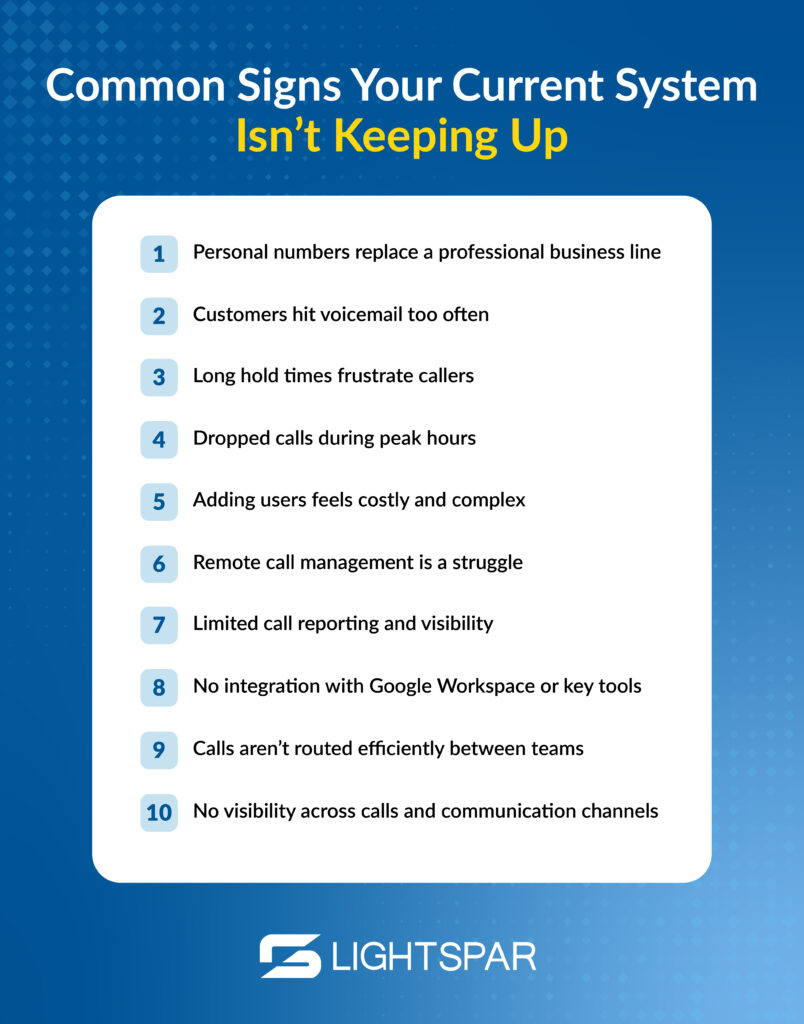
Common Signs Your Current System Isn’t Keeping Up
Many businesses wait too long to upgrade because communication issues build gradually.
Here are a few signs your current business phone solution may already be limiting growth:
- Employees use personal mobile app accounts instead of a centralized business phone number or virtual phone numbers
- Customers frequently reach voicemail or experience long hold times
- Your current setup creates dropped calls during busy hours
- Adding users or locations feels expensive or complicated
- Your team struggles to manage phone calls remotely
- Reporting and call visibility are limited
- Communication tools don’t integrate with Google Workspace or other daily software
- Teams struggle to route calls efficiently between departments
- You lack call handling visibility for incoming and outgoing calls across multiple channels
If any of these problems sound familiar, your phone systems may already be creating operational bottlenecks.
The best business phone system should make it easy for employees to answer business phone calls from desk phones, laptops, or mobile app platforms while keeping communication organized across departments.
Choosing the Right Provider Matters Too
Technology is important, but so is the company behind it.
Growing businesses benefit from providers that offer guidance, support, and flexibility rather than forcing businesses into oversized enterprise solutions they don’t need.
The right partner helps you build scalable business communications around your actual goals instead of selling unnecessary complexity.
That includes helping businesses:
- Choose the right features
- Scale gradually over time
- Support remote employees
- Add AI features where they make sense
- Avoid disruptive migrations later
- Integrate with customer relationship management platforms and other collaboration tools
Many growing companies compare how Google Voice or Zoom Phone integrates because they’re familiar names. The reality is that the best fit often depends on how much flexibility, support, and scalability a business actually needs.
Cloud-based phone system costs depend on features and pricing details. While some providers require long contracts, many modern service plans now offer flexible month-to-month options.
A phone system should simplify growth, not create another layer of frustration.
Build for Where Your Business Is Going

Growth is exciting, but it also exposes weak systems quickly.
Choosing a scalable small business phone system early helps businesses stay agile, responsive, and prepared for what comes next. Instead of constantly patching communication problems, businesses can focus on serving customers and growing confidently.
Modern cloud phone systems and AI-powered business communication tools make it easier than ever for small businesses to operate efficiently without enterprise-level complexity.
The right system won’t just support your business today. It will continue supporting your team, customers, and growth plans long after the next stage of expansion begins.
Ready to get started with a business that builds for your future? Contact us today!