
What Are Managed WAN Services?
Managed WAN services give multi-location businesses a centralized way to design, monitor, manage, and support connectivity across offices, stores, branches, and facilities.
Instead of asking an internal IT team to coordinate carriers, maintain network configuration standards, troubleshoot outages, and track network performance at every site, a managed service provider takes on much of that work.
For a growing multi-location network, the advantage is consistency.
Businesses can bring network connectivity, support, visibility, and WAN management into one model. LightSpar combines multi-carrier managed connectivity, built-in failover, centralized management, scalability, and engineering support.
Over 60% of enterprises are adopting SD-WAN for enhanced security.
Why Do Multi-Location Businesses Need Managed WAN Services?
Every location adds another layer to the network infrastructure. One site might use fiber, another broadband internet, and another multiple connections for redundancy, alongside different network devices, physical network equipment, network protocols, and carrier requirements.
Without consistent network management, network administrators may spend too much time coordinating each service provider, resolving local issues, and keeping network policies aligned. That makes network operations harder to standardize and pulls in-house expertise from higher-value work.
A robust network infrastructure gives businesses a repeatable foundation for growth. With managed WAN, new sites don’t have to become new networking projects.
How Do Managed WAN Services Work?
A provider can handle carrier coordination, network monitoring, proactive monitoring, managed customer premises equipment, troubleshooting, advanced reporting, and optimization. Support might run through a network operations center, while service level agreements (SLAs) clarify responsibilities and response expectations.
In a fully managed model, the provider manages more of the environment. Others keep direct control over selected systems while a third-party provider handles specific WAN services or network services, improving network uptime and reducing the burden on the IT team.
What Are the Main Benefits?
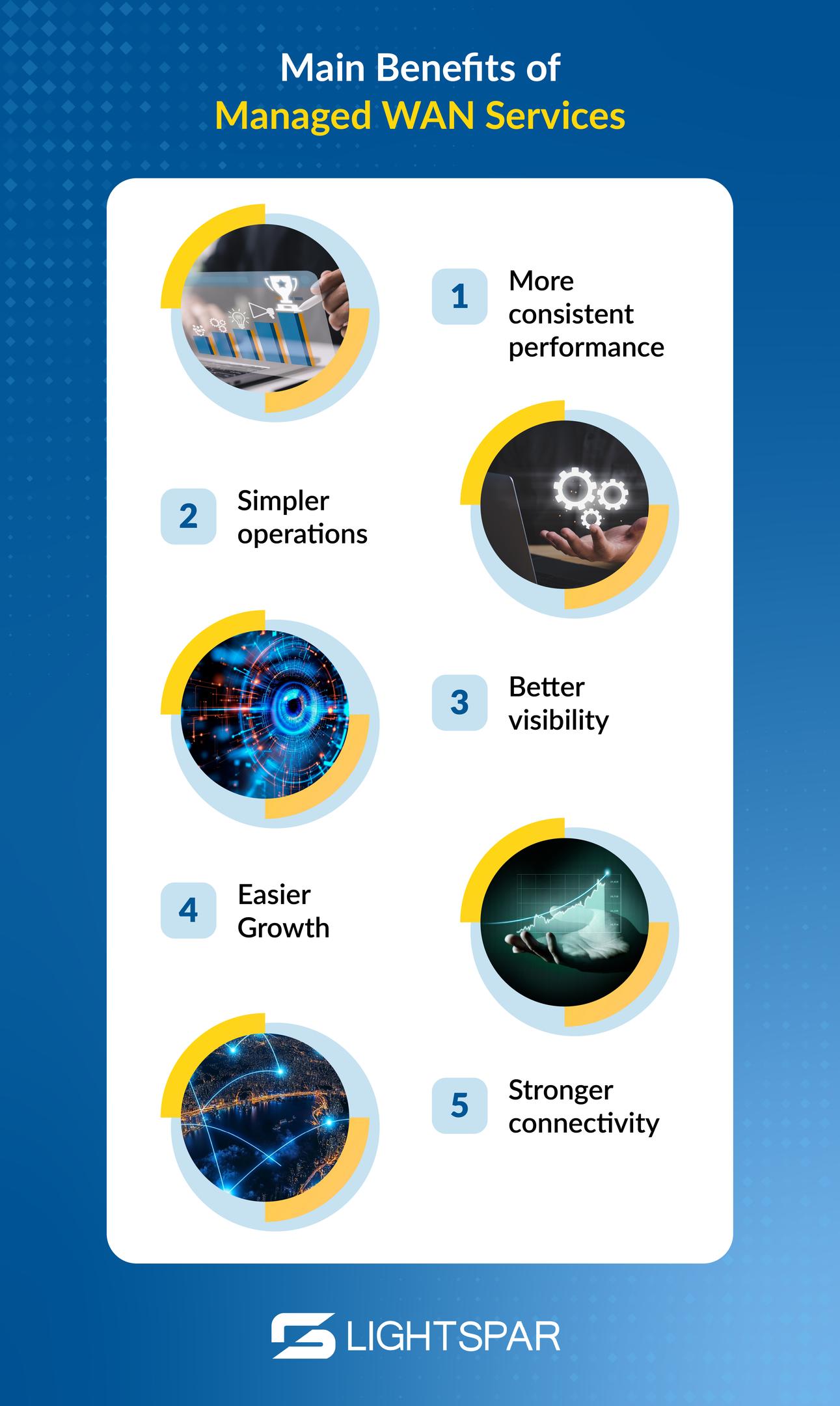
Managed WAN can support:
- More consistent performance: Failover and proactive monitoring help protect critical applications and secure connectivity when a circuit has trouble.
- Simpler operations: Fewer carrier handoffs can create cost savings and reduce routine troubleshooting.
- Better visibility: Centralized tools help teams understand network traffic, connection health, and available network resources.
- Easier growth: Managed network services can extend business network services to new locations while maintaining consistent standards.
- Stronger connectivity: A repeatable model supports enhanced connectivity without rebuilding the network at every site.
How Do SD-WAN and Managed WAN Services Work Together?
SD-WAN refers to a software-defined wide area network that uses software-based policies to steer traffic across available connections rather than relying on one fixed route.
SD-WAN technology can improve network performance by intelligently routing traffic according to connection quality, application needs, and business priorities. The resulting SD-WAN network may use fiber, LTE, or other paths.
A managed SD-WAN solution adds provider-led design, deployment, monitoring, and support. Managed SD-WAN services can include SD-WAN design, SD-WAN infrastructure planning, policy management, SD-WAN operations, and ongoing optimization.
I yr bs i comparing managed SD-WAN providers, you should ask how each supports managed SD-WAN deployments after launch. Is it fully managed? How are changes handled? A good SD-WAN vendor should make responsibilities clear.
If your business has in-house expertise, DIY SD-WAN can offer more direct control. This approach may suit teams equipped to manage the SD-WAN environment; for leaner teams, managed SD-WAN can reduce that workload. When vendors describe service SD-WAN packages or different SD-WAN offers, compare the operating model rather than the label.
How Do WAN Management and Network Security Work Together?
A secure WAN should support both availability and network security. Depending on the business, that can include encryption, segmentation, intrusion detection, prevention systems, and controls around network resources.
Some businesses also consider secure access service edge architectures that combine networking and security. These might include access service edge capabilities, zero trust network access, a secure web gateway, or a cloud access security broker.
The goal is a comprehensive network security environment that reflects how employees, locations, devices, and cloud services connect.
When Should You Consider Managed WAN Services?
It might be time when carrier coordination is consuming too much IT time, SD-WAN deployments are difficult to standardize, network monitoring is fragmented, or inconsistent network configuration is affecting reliability.
If routine connectivity work is crowding out strategic priorities, managed WAN services can simplify network operations while giving internal teams better visibility across locations. Managed SD-WAN also offers predictable monthly pricing without upfront costs.
What Should You Look for in a Managed WAN Provider?
Choosing the right provider requires assessing their industry experience. Evaluate carrier reach, failover, monitoring, security, reporting, support, and scalability. Ask who owns network configuration, which network devices are covered, and how issues are escalated.
When evaluating managed SD-WAN providers, also review the SD-WAN infrastructure, support model, and ongoing ownership.
Managed SD-WAN FAQs
What Is the Difference Between Managed WAN and Managed SD-WAN?
Managed WAN is the broader outsourcing model for WAN design, connectivity, monitoring, and support. Managed SD-WAN applies that model specifically to SD-WAN technology and combines an SD-WAN solution with ongoing provider management.
Is Fully Managed SD-WAN Better Than DIY SD-WAN?
Not always. Fully managed SD-WAN can suit businesses that want a provider to handle day-to-day operations, while DIY SD-WAN can work for organizations with the staff and expertise to manage more internally.
How Can Managed WAN Improve Uptime?
Managed WAN services can combine proactive monitoring, redundant connections, failover, and centralized troubleshooting to help maintain reliable connectivity across distributed locations.
Build a More Consistent Network With LightSpar

Managed WAN services help multi-location businesses simplify WAN management, improve network performance, and create more consistent network connectivity across every site.
By combining managed connectivity, centralized support, proactive monitoring, and scalable business network services, LightSpar helps businesses reduce complexity and build a stronger foundation for growth.
Contact us and start building your stronger foundation today!