
Quick summary
Business continuity is an organization’s ability to maintain critical work during and after a disruption. For a small business, that often starts with phones, internet, and the network your team uses every day.
- A business continuity plan helps your company respond when a power outage, cyber issue, equipment failure, or natural disaster interrupts business operations.
- A major business benefit, especially for SMBs, is the cloud infrastructure that runs our world. Whether it’s cloud voice, cloud computing, or network redundancy, these solutions can keep people connected when the primary connection fails.
- Failover lets calls or internet traffic automatically switch to another route, so customers aren’t left with silence and confusion.
When the Phones Go Quiet, Business Continuity Needs to Immediately Kick in
It’s the perfect storm: You’re close to the end of a quarter, you have some sales incentives running, and the time to pull the trigger is running out. A sales lead finally calls back and is ready to close. On another line, one of your largest customers is calling about an invoice. Then, a vendor needs approval on a credit increase.
It’s all the excitement of running a business, and then the phones stop.
In an instant, there’s worry and confusion as to what’s going on. Someone asks, “Is the internet down?” Someone else says, “I thought the phones were separate.” The next 5 minutes are a blur while you try to figure out what’s going on.
Quickly, business continuity stops being a binder on a shelf and becomes the thing your business needs right now to get back on track.
Where to Begin to Avoid Downtime
A business continuity plan is so much more than a checkbox disaster recovery document. It’s a practical plan for keeping the organization working when normal systems fail. It should account for phones, data, security, facilities, people, cloud tools, and the processes your team follows in a crisis. Most importantly, you need to review the plan at least annually to ensure it still makes sense and that all bases are covered.
For many industries, the importance of business continuity goes beyond the comfort of having a security blanket. It really comes down to having financial protection, customer trust, compliance, and recovery. If customers can’t connect with you during a disruption, they may call someone else, and that’s definitely not what you want.
Why Voice Belongs in Your Business Continuity Strategy
What’s the first thing that happens when you drop and break your cell phone? Your brain starts racing through everything you just lost: pictures, music, documents, etc. But with the mass adoption of iCloud and Google Drive backups, that fear can almost completely disappear. Same idea for business continuity, but with one caveat: Communication is often what breaks the customer experience first.
Business continuity in regard to communications means your company can respond, recover, resume, and restore operations after disruption. Disaster recovery is related but narrower. Disaster recovery focuses on restoring IT systems and data. Business continuity covers the whole business, including people, facilities, services, customers, suppliers, and recovery operations.
An in-depth business continuity strategy should identify areas where a single failure could trigger a larger outage. Your phones are one of those areas.
- If the office connection fails, can calls still route to mobile devices?
- If a natural disaster closes one location, can another location answer?
- If one carrier has trouble, does your network have another path?
The size of your business doesn’t matter when it comes to whether you need a plan. The complexity will be different, but a five-person business still needs a plan.
Learn more about LightSpar’s Unified Communications and network connectivity.
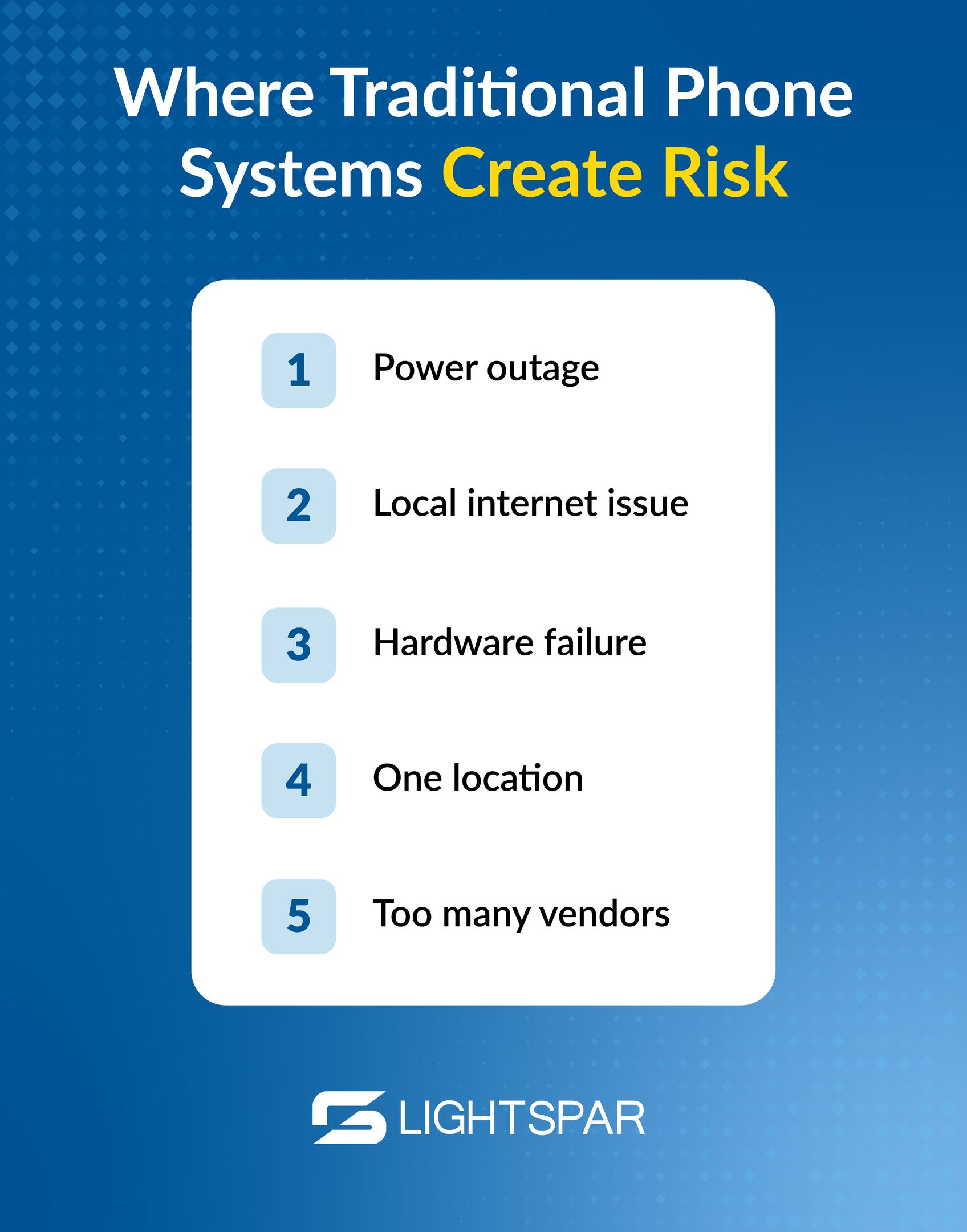
Where Traditional Phone Systems Create Risk
Older phone systems can be a linchpin in the success of your business continuity solutions. They were built for a world where everyone sat in one office.
Risk | What It Looks Like | Better Question to Ask |
Power outage | Office phones stop working | Can calls route somewhere else? |
Local internet issue | Cloud apps and calls slow down | Do we have a failover internet connection? |
Hardware failure | Old equipment takes down voice | What services protect us if it breaks? |
One location | Calls only ring in one building | Can other locations help? |
Too many vendors | Other providers point fingers | Who owns the fix? |
How Cloud Voice, Failover, and Redundancy Help
Cloud Communication
Cloud communication means voice, messaging, meetings, and collaboration tools are delivered through the cloud instead of one phone box in the office. With LightSpar’s Unified Communications services, a team can use cloud calling, video meetings, chat, messaging, mobile app features, call forwarding, call queue management, IVR, and integrations with business apps.
This is a huge help for business continuity because your team can work from office phones, laptops, tablets, or mobile devices. If one location is down, another user can still respond.
Failover Internet
Failover internet is a backup internet connection that takes over when the primary internet connection fails. An outage is the failure itself. Failover is the process that helps reduce the impact of that outage.
Yes, you can split an internet connection between two routers, but most businesses should use the right equipment and network design instead of a homemade setup. Dual-WAN routers, SD-WAN, or managed network solutions can balance traffic, establish backup paths, and keep voice quality under control.
5G Failover
5G failover uses a 5G wireless connection as the backup path. If the main wired connection goes down, traffic can automatically switch to 5G. It’s not a magical fix-all, but it is a smart protection layer for critical tools.
What a Business Continuity Solution Should Include
A business continuity solution is the mix of people, technology, resources, and practices that helps an organization maintain services during a crisis. The key elements include risk review, business impact analysis, communication rules, recovery targets, data backup, training, testing, and leadership ownership.
The business impact analysis (BIA) precedes the business continuity plan (BCP). The BIA shows what’s critical, the financial impact, and how quickly recovery needs to happen. Then the business continuity plan turns that knowledge into steps.
Tabletop exercises and simulated drills help organizations practice response scenarios without halting operations. Testing a business continuity plan is essential because it helps staff know their roles and find gaps before a real disaster. Best practice is to test at least once a year and give key stakeholders a clear way to review results.

Why LightSpar Fits the Business Continuity Conversation
At LightSpar, we’re doing more than selling phones. We help businesses connect voice, cloud, network, contact center, security, and support into one plan, and most importantly, work with one vendor.
If your business continuity plan still depends on one office, one connection, or one aging phone system, it’s worth a comprehensive review. LightSpar can help identify weak spots, establish better call paths, and develop communication solutions that keep your business reachable when the day gets messy.
And messy days do happen.
A natural disaster, power outage, carrier issue, cyber event, or simple equipment failure can quickly interrupt business operations. The goal is not to predict every problem. The goal is to prepare your team, protect the customer experience, and give your business a better shot at success when something breaks. Contact us today to start your business recovery efforts before the next outage occurs.