
Quick summary
Managed Network Services are becoming more critical to the daily operations of any business. They help businesses keep their network reliable, secure, and ready for daily work. Here’s the short version:
- Managed Network Services give your business proactive network monitoring, support, and management.
- Unmanaged networks can lead to downtime, slow applications, security gaps, frustrated employees, and disconnected operations.
- A big win is proactive monitoring, which helps find problems before they interrupt customers or staff.
- Strong network management supports business continuity, especially for cloud apps, remote teams, and multi-location businesses.
The Network Management Problem Most Business Owners Don’t See Coming
The reality is that you don’t really think about changing your current setup until there’s a reason to. Well, let’s look at a common scenario and see if it rings true for you.
The workday starts like any other. Your team logs in, and the phones immediately start ringing. Hey, congrats, you have an in-demand business, and customers are eagerly waiting. You have a few employees working from home at any given time. Your accounting software is now in the cloud. Your sales team is a heavy user of video calls, and your customer service team is locked in trying to answer questions fast.
Then, all of a sudden, everything begins to slow down.
Calls are getting choppy and increasingly frustrating, with people having to repeat themselves. The cloud apps that are integral to every aspect of your business start to lock up and freeze. The important video meeting with a large prospect drops completely. Someone yells out from an office, “Is the internet down?” Someone else says, “Yup, it was doing this last week, too. Just wait a few minutes, and we should be fine…hopefully.”
Now the workday has turned into a hope and a prayer.
The problem is simple: unmanaged networks. They aren’t usually deliberately created like that, but as you grow and add people and services, it just happens. And when something breaks, the business pays for it in lost time, missed calls, poor customer experience, and stressed-out employees.
Managed Network Services are here to help prevent that kind of mess. Keep reading to learn how.
What Are Managed Network Services?
Managed Network Services involve outsourcing the monitoring, management, and support of your business network to a specialized provider.
In other words, it means you have technical experts who keep an eye on your network, helping maintain performance, and stepping in when something needs attention.
That can include:
Network Need | Why It Matters |
Network monitoring | Helps detect problems before they disrupt work |
Network management | Keeps devices, connections, and traffic organized |
Network security | Helps protect data, users, and systems from threats |
Performance optimization | Helps voice, video, and cloud apps run better |
Scalability | Let’s your network grow as your business changes |
Support | Gives your team expert help without hiring more staff |
For many small and mid-sized businesses, the value is simple: you get expert talent without building an expensive, full in-house network team.
The Business Risk of the “We’ll Fix It When It Breaks” Mentality
All too often, businesses manage their network only when there’s a problem. At first thought, that may feel cheaper, but in reality, reactive support gets expensive fast.
When a network is unmanaged, small issues can sit quietly in the background waiting to bounce and make their presence known.
A router may be right at the edge of being overloaded. A firewall may need attention because a lack of maintenance has left it on the verge of failure. A remote employee may be using an unsafe connection. A branch office may be dealing with weak performance every afternoon. Cloud apps may be slow because traffic is not being routed well.
None of these problems may seem huge on their own, but together, they create a heavy drag across the board. The unknown of what’s going to hit next is not a great way to run things.
How Managed Network Services Reduce Downtime & Boost Business Continuity
Downtime is no longer something you need to just get through. The interruptions are more than a technical issue; it’s a business issue.
If your phones, internet, payment systems, file access, or cloud software stop working without warning, at the very least, your business slows down. But in some cases, it stops completely.
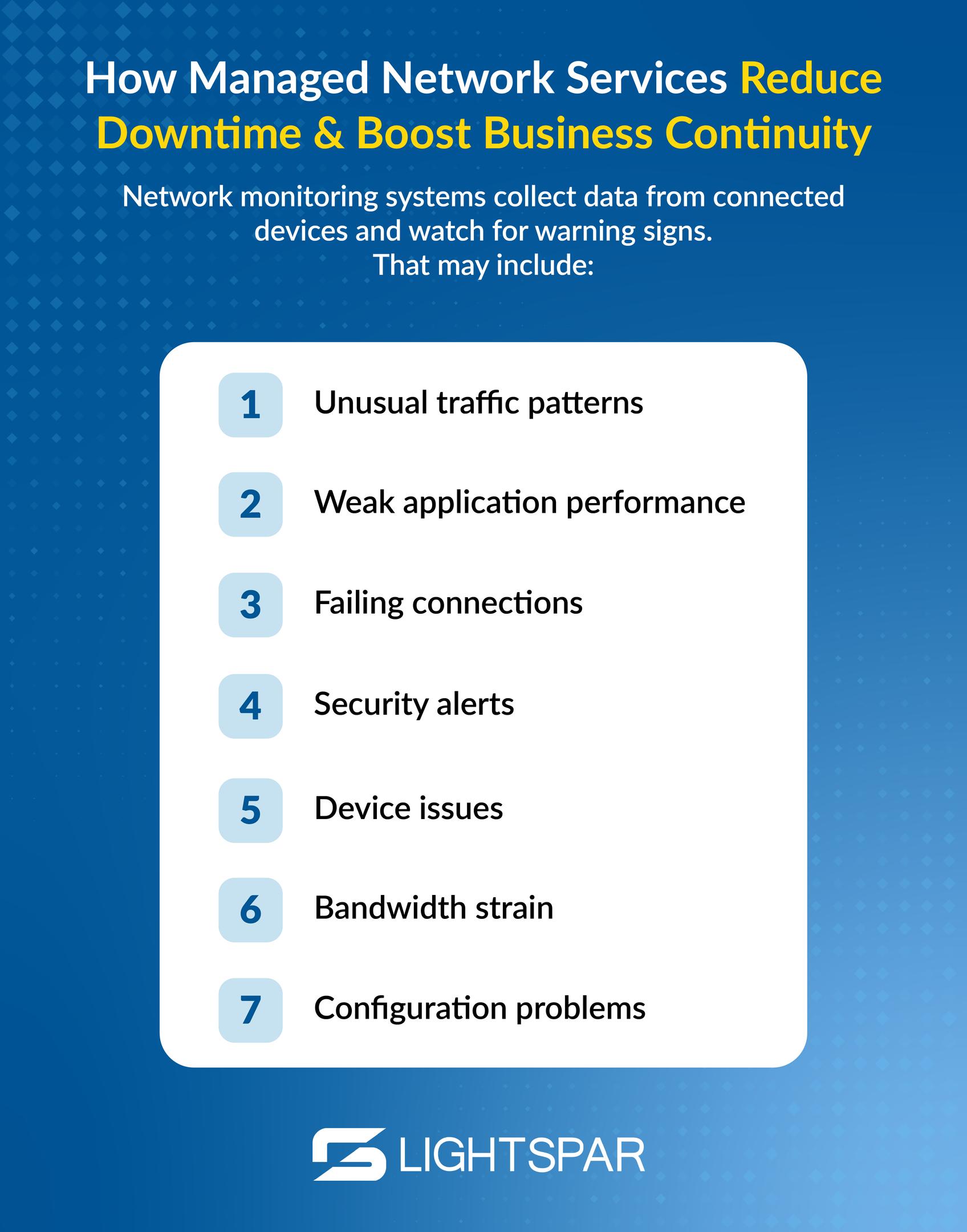
Managed Network Services reduces downtime through proactive monitoring and support. Instead of waiting for users to report a problem, network monitoring systems collect data from connected devices and watch for warning signs.
That may include:
- Unusual traffic patterns
- Weak application performance
- Failing connections
- Security alerts
- Device issues
- Bandwidth strain
- Configuration problems
At the end of the day, the goal is to catch and stop more system issues before they become visible to the whole company.
That’s exactly where business continuity comes in.
A good business continuity plan helps key functions continue during disruptions. ISO 22301, the international standard for business continuity management, focuses on preparing organizations to keep operating through disruptive events.
Your network plays a major role in that plan.
If your team depends on cloud tools, remote access, phones, video meetings, and shared files, your network has to be treated as part of your continuity strategy. Not as an afterthought.
A Use Case: The Growing Business With Too Many Network Problems
Our client base has grown because adding products and services is easy, but long-term maintenance has become a concern. So here’s an example of what that looks like. Let’s say a business has 45 employees, two offices, a few remote workers, and several cloud-based applications.
For years, its setup was simple enough. One internet provider. A basic firewall. A few switches. Some Wi-Fi. A phone system. Nothing fancy, but it got the job done.
Then the business started to grow, and client expectations grew with it.
Now the team uses more video meetings. The phones run over the network. Files are stored in the cloud. Remote workers need secure access. The second office needs consistent performance. The owner wants better security, but the internal IT person is already stretched thin trying to keep up.
The old setup is still technically working, but it’s not working well.
Here’s exactly where Managed Network Services make sense.
With the right partner, the business can move from “hope it keeps working” to a managed plan. The network can be reviewed, monitored, secured, and built around how the business actually operates.
And based on your business, your network may need dedicated internet access, private network options, SD-WAN for remote or hybrid teams, secure traffic routing, built-in failover, and ongoing support.
The best part is the owner doesn’t need to become a network expert. The IT person doesn’t have to carry the whole burden alone. And employees get a better daily experience. Everybody’s happier.
Why Network Security Belongs in the Conversation
Network performance matters. But network security matters just as much.
A weak network can expose your business to malware, ransomware, unauthorized access, and data loss. Firewalls help filter traffic. VPNs can encrypt connections for secure remote access. Network segmentation can help limit how far a threat can spread. Antivirus tools can help detect and remove malware.
But tools alone are not enough. They need to be managed and monitored.
Managed Network Services can include firewall management, intrusion detection, patching, configuration updates, and security monitoring. That matters because many security problems come from gaps that no one noticed or settings that were never updated.
For a busy business owner, that peace of mind is a very big deal.
How LightSpar Helps Businesses Stay Connected
LightSpar helps businesses build and manage the network foundation that supports daily operations.
Our network services have what your business needs to stay connected and secure. Our solution covers private network options, dedicated internet access, and multi-carrier connectivity across the United States. That means businesses can connect locations, support voice and video, and avoid managing multiple providers for different parts of the network.
But we don’t stop there because we also support SD-WAN for companies with remote teams, hybrid work, cloud applications, and multiple locations. SD-WAN helps route traffic more efficiently, improve access to SaaS tools, and support secure connectivity for users working outside the office.
For those running a business, the real value is knowing the network has a plan. Knowing there’s support when something changes. Ultimately, you win by having a partner that can help design, implement, manage, and scale the network as the business grows.

Managed Network Services Make Growth Easier
Growth is good. Nay, growth is great, but growth puts pressure on your network.
More employees mean more devices. More locations mean more connections. More cloud tools mean more demand on internet performance. More remote work means more need for secure access.
Managed Network Services help your network grow with your business instead of holding it back.
The power lies in helping turn unpredictable IT costs into more predictable monthly costs. Instead of waiting for something to break and then paying to clean it up, businesses can plan ahead with ongoing management, support, and maintenance.
This makes for straightforward budgeting. And it’s better for everyone who just wants the workday to run without drama.
Is Your Network Helping or Hurting the Business?
Network management usually doesn’t lead the discussions at the quarterly retreat. And that’s okay with us. Working hard in the background to keep the business moving forward is what Managed Network Services is all about.
People will care when calls drop. They care when employees are unable to work. They care when customers get a bad experience. They care when cloud apps slow down during the busiest part of the day.
Managed Network Services are there for the critical, always-on business operations.
They help maintain uptime, support business continuity, improve network performance, strengthen network security, and provide your team with expert help without adding another full-time hire.
If your business depends on reliable connectivity, it may be time to stop treating the network like background noise.
Talk with LightSpar today about your network management needs and find out how Managed Network Services can help your business stay connected, protected, and ready for what comes next.